Televarpið (Faroe Islands): TV-as-a-Service Reaching ~100% of Households | Smartlabs Case Study
How Televarpið — TV-distribution arm of Faroese Telecom Group — launched a streaming platform in Faroese, Danish, and English, reaching almost 100% of Faroese households. Delivered as TVaaS.
Faroe Telecom
TV-distribution subsidiary of Faroese Telecom Group (Føroya Tele) · Established 2002
TelecomFaroe Island
Televarpið streaming service launch · Faroe Islands · 2024
~100%
The headline number
of Faroese households reached by the combined digital transmission networks.
A national TV service with near-complete household-level reach, delivered as TV-as-a-Service.
~100%
Faroese households reached
3
native UI languages (Faroese, Danish, English)
18
islands served
At a glance
The engagement
Customer
Televarpið — TV-distribution subsidiary of Faroese Telecom Group (Føroya Tele), established in 2002 to bring digitised television to the Faroese nation
Region
Faroe Islands — autonomous territory of the Kingdom of Denmark, ~54,000 people across 18 islands
Service
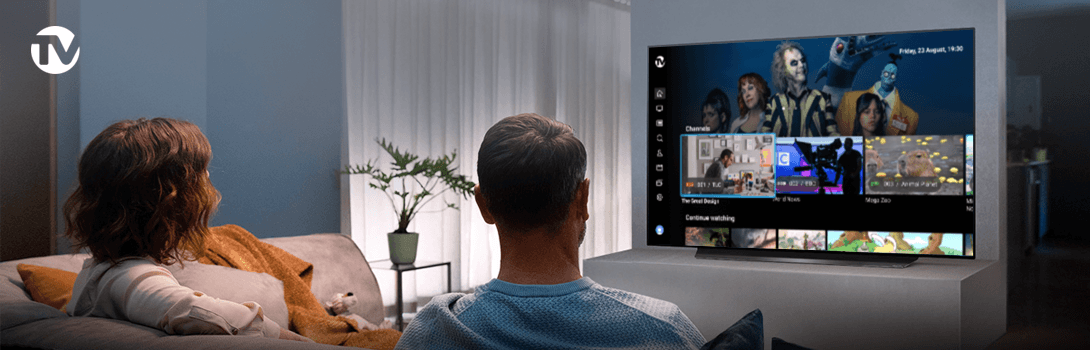
Linear TV, network DVR, and video-on-demand across STB, mobile, web, and Smart TV — native UI in Faroese, Danish, and English
Smartlabs scope
SmartTUBE Ultra Service Delivery Platform; SmartTUBE Ultra Applications (STB, mobile, web, Smart TV) with full UI customisation in Faroese, Danish, and English; SmartTUBE Ultra Browser Application for legacy STBs; SmartMEDIA (transcoding, packaging, streaming, recording, VoD ingest); SmartCARE QoE analytics; Smartlabs Universal DRM (Widevine, FairPlay); Android STB SML-5045W; Premium Level Support and Maintenance
Commercial model
TV-as-a-Service (TVaaS) — platform delivered as a managed service
Televarpið was established in the summer of 2002 as a subsidiary of Faroese Telecom (Føroya Tele) with a specific aspiration: to bring digitised television to the Faroese nation. The Faroe Islands — a self-governing territory of the Kingdom of Denmark in the North Atlantic with a population of approximately 54,000 spread across 18 islands — had been served by analogue terrestrial television prior to Televarpið's launch. In December 2002, just months after Televarpið's establishment, the Faroe Islands became the first country in the world to fully switch off analogue television in favour of the digital DVB-T standard. Televarpið's digital terrestrial network was the technical foundation of that transition.
In the two decades that followed, Televarpið grew into the principal commercial distributor of television in the Faroes, carrying the national public broadcaster Kringvarp Føroya alongside Scandinavian, British, and international channels — DR1, DR2, TV2 family, NRK1, BBC, Eurosport, Discovery, Disney, National Geographic, and many others. The parent company, Faroese Telecom Group, holds a market share of 75–80% across mobile, broadband, fixed line, and TV in the Faroese market and has been actively rolling out 5G mobile coverage alongside a nationwide fibre-to-the-home programme aimed at gigabit speeds for every Faroese household.
That national-infrastructure ambition is what shaped the TV-platform decision Televarpið needed to make in 2023–2024.
01 — Challenge
What Televarpið needed to solve
By 2024, Televarpið's TV service needed to evolve along several dimensions at once, against operational constraints specific to a small-market, geographically remote, multi-lingual environment.
01
A streaming-era viewing experience expected by every household
Faroese subscribers were watching the same Scandinavian and international content on the same iPhones, Android phones, Smart TVs, and tablets that subscribers in Copenhagen, Stockholm, or London were using. The platform needed to deliver a streaming experience comparable to those reference services — multi-device, modern UX, adaptive bitrate, instant on — across the consumer device categories Faroese households actually own.
02
A legacy STB fleet that could not be discarded
Televarpið had a substantial installed base of legacy set-top boxes deployed in subscribers' homes. Replacing them through a national truck-roll programme was not commercially or operationally viable in a market of 54,000 people spread across 18 islands. The new platform had to integrate those legacy devices alongside modern Android STBs — not replace them.
03
Full native localisation in three languages
Faroese is one of the world's smaller national languages, spoken by approximately 70,000 people in total. Generic streaming platforms with off-the-shelf localisations don't cover Faroese — and treating a national TV service as anything less than fully native in Faroese would have been commercially unacceptable. The platform also needed full Danish and English coverage for the multi-language realities of Faroese households.
04
Operational economics matched to a small market
For an operator serving a national market of fewer than 30,000 households, the platform decision had to be commercially structured for that scale — not a tier-one telco template scaled down. TV-as-a-Service, with platform delivery and operations bundled together as a managed offering, made structural sense in this environment in a way that traditional capex-heavy platform purchases did not.
05
Premium-content protection through universal DRM
Major content licensors that supply Televarpið — Danish public broadcasters, Scandinavian commercial broadcasters, and international content providers — increasingly require hardware-rooted DRM across the device fleet. The platform needed full Widevine and FairPlay coverage to ensure those licences could be carried without per-device negotiation.
02 — Decision
Why Smartlabs
Televarpið selected Smartlabs after evaluating the available IPTV/OTT platforms in the market. Three factors shaped the decision.
01
A complete TV-as-a-Service offer covering the full stack
SmartTUBE Ultra for middleware, SmartMEDIA for content processing, SmartCARE for analytics, Universal DRM for content protection, applications for STB / mobile / web / Smart TV, and modern Android STB — all delivered as a managed-service package rather than a multi-vendor integration project. For a small-market operator, single-vendor end-to-end TVaaS reduced the operational burden the platform decision would otherwise impose on Televarpið's own technical team.
02
Native multi-language UI customisation, including Faroese
Smartlabs' SmartTUBE applications framework supports per-deployment text localisation as part of standard customisation. Delivering the entire end-user experience in Faroese, Danish, and English was a documented capability — not a bespoke development effort priced separately. The same applied to the operator's visual identity: logos, colours, and layout adjustments are part of the standard customisation framework.
03
Proven legacy-device integration
Smartlabs had executed legacy STB integrations at multiple operators globally — including the remote migration of full subscriber bases on existing hardware. The SmartTUBE Ultra Browser Application path for the legacy fleet was a known workflow rather than an experimental approach, giving Televarpið confidence that the existing in-home device base could be preserved through the platform transition.
“Our collaboration with Smartlabs has produced great results. The combined digital transmission networks now reaches almost 100% of Faroese households. The updated system is designed for flexibility and interactivity, making content more accessible and engaging.”
03 — Solution
What Smartlabs delivered
Smartlabs delivered an end-to-end TV-as-a-Service platform built around five integrated layers, each addressing a specific dimension of the Faroese market requirement.
Service delivery (SmartTUBE Ultra)
SmartTUBE Ultra handles the core middleware functions for Televarpið's TV service: subscriber accounts, content metadata, electronic programme guide, entitlement checks at every playback request, multi-profile management, and concurrent-device session control. The platform supports integration with Televarpið's existing OSS and BSS systems through the SmartTUBE API set, and provides integration paths for third-party streaming content sources within the unified Televarpið experience. SmartTUBE's recommender subsystem provides personalisation across the catalogue.
Multi-device applications with Faroese-first localisation
The SmartTUBE Ultra applications cover every consumer device category Faroese households use:
Set-top boxes — modern SML-5045W AOSP STBs running the SmartTUBE Ultra UI for new customer installations, alongside the SmartTUBE Ultra Browser Application running on the legacy set-top boxes that subscribers already have in their homes.
Mobile — native iOS and Android applications for phones and tablets, with offline downloads, multi-profile support, and full state synchronisation through the SmartTUBE backend.
Smart TVs — applications for Samsung Tizen, LG webOS, and Android TV televisions, distributed through the manufacturers' official TV stores.
Web — browser-based access for desktop and laptop viewing.
Every screen presents the service in Faroese, Danish, and English, with logos, colours, text colour and sizing, and background imagery customised to Televarpið's visual identity. The user experience is consistent across all device classes — same content rails, same Continue Watching state, same recommendations — synchronised through the SmartTUBE backend.
Content delivery (SmartMEDIA)
SmartMEDIA handles content processing and delivery for the IP-delivered portion of the service. The deployment covers four functional areas: real-time transcoding of TV channels to adaptive-bitrate ladders (1080p / 720p / 576p output profiles); packaging and streaming for HLS and MPEG-DASH delivery to all device classes; recording infrastructure supporting Network DVR; and VoD ingest for on-demand content. The transcoding capacity is structured to scale as the linear lineup grows.
Quality of experience monitoring (SmartCARE)
SmartCARE was deployed alongside the rest of the platform to give Televarpið continuous visibility into service quality across the deployed estate. The system collects client-side metrics (buffering events, bitrate switches, startup time, MOS, device and network conditions) alongside server-side telemetry, and applies clustering analysis to identify groups of subscribers experiencing similar issues. For an operator delivering service across a geographically distributed island nation, that visibility is operationally valuable — issues can originate in any of several delivery paths and need to be diagnosed accordingly.
Content protection (Smartlabs UDRM)
Universal DRM provides hardware-rooted content protection across the device fleet: Google Widevine for Android STBs and Chromecast-compatible devices, Apple FairPlay for iOS and macOS Safari. A single integration layer covers both systems, eliminating the per-DRM operational overhead that fragmented protection stacks impose. The unified DRM coverage is what allows Televarpið to carry premium content from Scandinavian and international licensors across all the devices the platform reaches.
Modern STB (SML-5045W)
New customer installations receive the SML-5045W — a compact Android-based set-top box built around the Amlogic S905Y4 SoC, with 2GB RAM, 8GB eMMC, dual-band Wi-Fi 802.11n/ac with Bluetooth 5.0, HDMI 2.0 output with HDCP 2.x, and Widevine L1 hardware-level DRM. The device is certified for CE and RoHS2 and ships with full Televarpið customisation including branded packaging, branded remote control, and a branded quick-start guide. The dual-track hardware architecture — legacy STBs retained for the installed base, SML-5045W for new growth — is the same pattern Smartlabs has executed at other operators (see the StarNet Moldova case study) and is the cost-effective alternative to a national device-replacement programme.
04 — Commercial model
The TV-as-a-Service model in practice
Televarpið's deployment is structured as TV-as-a-Service — a commercial and operational model in which platform delivery, ongoing operations, and support are bundled into a managed service rather than purchased as separate capital and operational components. For an operator with Televarpið's profile, that structure carries specific advantages:
Predictable per-subscriber economics. Platform cost scales with the active subscriber base on a known per-account basis, rather than requiring large upfront capital investment followed by uncertain operational costs.
Vendor-side operational depth. Day-to-day platform operations — version upgrades, security patches, capacity tuning, monitoring against the SmartCARE telemetry — leverage Smartlabs' operational experience across deployments in 15+ countries, rather than requiring Televarpið to build the operational expertise in-house at a scale that the Faroese market alone could not justify.
Roadmap inheritance. New SmartTUBE features — AI-driven recommendations, predictive churn detection, FAST channel monetisation, refreshed UX patterns — become available to Televarpið through the standard upgrade path rather than as bespoke development projects.
Faster time-to-value. TVaaS removed the months of platform-procurement, hardware-sizing, and integration ramp that a self-hosted deployment would have required, compressing the timeline from contract to subscriber-facing service.
“We are happy to serve Televarpið and deliver a comprehensive video streaming solution to Faroe households supporting existing legacy devices as well as modern set-top-boxes, web browsers, SmartTVs, iOS and Android mobiles.”
05 — Results
Live across the Faroe Islands
Streaming TV service reaching almost 100% of Faroese households — as stated by Televarpið's CEO in the public announcement: "the combined digital transmission networks now reaches almost 100% of Faroese households."
Multi-device coverage across every consumer surface. Modern Android STBs, legacy STBs preserved through browser integration, iOS and Android mobile, web, and three Smart TV platforms (Samsung Tizen, LG webOS, Android TV) — all from a single platform.
Native Faroese-Danish-English UI delivered across every device class. Faroese — a national language with roughly 70,000 speakers — is treated as a first-class platform language, not as an afterthought.
Legacy STB fleet preserved and integrated, not replaced. Existing subscribers retained the set-top boxes they already had; only new customers receive the modern SML-5045W. No national truck-roll programme was required for the platform transition.
Premium content protected through Widevine and FairPlay across the device fleet — enabling integration with licensed content sources without per-device DRM fragmentation.
Operational efficiency achieved through TV-as-a-Service. Televarpið's CEO publicly attributed the deployment outcome to outcome-based goals rather than capability-driven procurement: "By prioritizing outcome-based goals, Televarpið has achieved excellent performance and operational efficiency."
06 — What's next
Roadmap on a managed platform
Televarpið's roadmap on the SmartTUBE platform follows the standard release cycle. New capabilities — refreshed UI/UX patterns, AI-driven recommendations, FAST channel monetisation as they become commercially relevant in the Faroese market — become available through the standard upgrade path. The TVaaS model means each new capability lands as a service-tier evolution rather than a procurement event, allowing Televarpið to evolve the offering against subscriber needs in step with how the wider streaming market evolves around it.
Frequently asked questions
What is Televarpið and how is it related to Faroese Telecom?▾
Televarpið is the TV-distribution subsidiary of Faroese Telecom Group (Føroya Tele), the incumbent telecommunications operator of the Faroe Islands. It was established in 2002 to bring digitised television to the Faroese nation and operated the country's digital terrestrial network from that point onward. The Smartlabs deployment extends Televarpið's service from terrestrial broadcasting into a full multi-device streaming experience.
What platform powers Televarpið's TV service?▾
The service runs on Smartlabs SmartTUBE Ultra, delivered as TV-as-a-Service: SmartTUBE Ultra Service Delivery Platform for middleware, SmartMEDIA for content transcoding and delivery, SmartCARE for analytics and QoE monitoring, Smartlabs Universal DRM (Widevine and FairPlay) for content protection, and the SmartTUBE Ultra applications framework for clients across STB, mobile, web, and Smart TV.
In which languages is the service available?▾
Televarpið's streaming service is delivered in Faroese, Danish, and English across every device class — set-top boxes, mobile applications, Smart TV applications, and the web client. Full localisation in all three languages was part of the initial deployment scope, not a retrofit.
What set-top boxes does Televarpið use?▾
Two device families. Modern Android set-top boxes — the SML-5045W (Amlogic S905Y4, 2GB RAM, 8GB flash, Wi-Fi 802.11n/ac, Widevine L1) — are shipped to new customer installations. Existing legacy set-top boxes are retained for the installed base and integrated through the SmartTUBE Ultra Browser Application. Subscribers with legacy devices kept the boxes they already had; only new customers receive the SML-5045W.
What is TV-as-a-Service and why does Televarpið use it?▾
TV-as-a-Service (TVaaS) is a managed-service commercial model in which platform delivery, ongoing operations, support, and roadmap evolution are bundled into a single service relationship rather than purchased as separate components. For a small-market operator like Televarpið — serving fewer than 30,000 households in a geographically remote location — TVaaS provides predictable per-subscriber economics, vendor-side operational depth at a scale the local market alone could not justify, and faster time-to-value than self-hosted platform procurement.
How is premium content protected on Televarpið?▾
Through Smartlabs Universal DRM — a single integration that delivers Google Widevine for Android-based devices and Apple FairPlay for iOS and Safari. The unified DRM coverage allows Televarpið to carry premium content from Scandinavian and international licensors without per-device protection fragmentation.
What share of Faroese households does the service reach?▾
According to Televarpið's CEO, as stated in the August 2024 announcement: the combined digital transmission networks now reach almost 100% of Faroese households. Most national TV operators describe reach in terms of network coverage or subscriber count; Televarpið operates a near-complete household-level reach within its national market.
Build a multi-screen TV service like Televarpið TV
Smartlabs has delivered carrier-grade IPTV and OTT platforms for telecom operators in 15+ countries, serving more than 7 million subscribers.