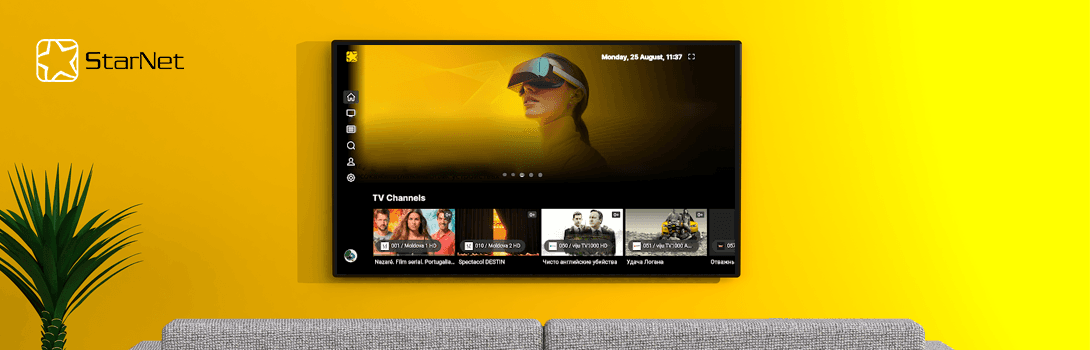
StarNet (Moldova): IPTV Platform Partnership Since 2019 | Smartlabs Case Study
How StarNet — Moldova's FTTx pioneer — migrated its full IPTV subscriber base to Smartlabs in 2019 and extended the partnership through 2029 with Hisense VIDAA and Fire TV apps.
StarNet TV multiscreen platform · contract extension through 2029 · 2025
Zero
engineer visits to homes
The full legacy STB fleet was migrated to SmartTUBE over the air in 2019 — no truck rolls, no device swaps, no service interruption.
March 2025 contract extension committed both companies to a five-year forward partnership through the end of 2029.
Zero
engineer visits to homes
2029
contract committed through end of
9
device surfaces from one platform
At a glance
The engagement
Customer
StarNet — Moldova's second-largest ISP and a leading triple-play service provider; FTTx pioneer for the Moldovan market (founded 2003 in Chișinău by Alexandru Machedon)
Region
Moldova (HQ in Chișinău; service across major towns and cities)
Service
StarNet TV — interactive IPTV with multi-screen extensions across mobile and Smart TVs
Smartlabs scope
SmartTUBE multiscreen middleware replacing legacy platform (2019); remote deployment of customised SmartTUBE UI on every legacy STB already in the field; branded SML-5050 UHD Android STB for new customers; client applications across mobile, web, and Smart TV / streaming-device platforms; Hisense VIDAA and Amazon Fire TV apps added in 2025
Replaced platform
StarNet's previous IPTV middleware — full back-end migration with the existing STB fleet retained
Initial migration
2019
Contract extension & expanded device coverage
March 2025 — extension valid through end of 2029
Platforms
Legacy STB (running SmartTUBE UI since 2019)SML-5050 UHD Android STBiOSAndroidSamsung TizenLG webOSAndroid TVHisense VIDAAAmazon Fire TV
StarNet is one of Moldova's defining telecommunications operators. Founded in 2003 in Chișinău by Alexandru Machedon, the company is the country's FTTx pioneer — the first ISP in Moldova to build a fibre-to-the-x access network and the first to offer fully unlimited 100/100 Mbit/s broadband (December 2010). By the time of the IPTV platform decision, StarNet had grown into the second-largest ISP in Moldova, sharing approximately 88% of the country's internet market with the incumbent Moldtelecom.
The company operates a nationwide fibre-optic network reaching all of Moldova's major towns and cities, with operations centred in Chișinău. The portfolio is triple-play — fibre broadband, IPTV, fixed telephony — plus enterprise ICT services for business, government, and public-sector clients. StarNet is positioned as the principal alternative operator to Moldtelecom and Orange Moldova in the Moldovan market.
01 — Challenge
What StarNet needed in 2019
StarNet's existing IPTV service had been built on a legacy single-screen middleware that had served the operator well through the FTTx growth years but was reaching the end of its useful life by the late 2010s. Three pressures pushed the operator toward a platform replacement, and one constraint shaped how it had to be executed.
01
Multiscreen as a competitive requirement
Moldovan subscribers — even in a market with deep, fast, cheap fixed broadband — had moved on from the assumption that TV happens only on the TV. Phones, tablets, and Smart TVs were where a growing share of viewing time was being spent, and the legacy platform was not architected to reach them.
02
A modern interactive feature set
The expectations of a streaming-era IPTV product — multi-device session control, cross-device handoff, modern UX, sustained roadmap for new features — required a platform actively under development by its vendor, not one in maintenance mode.
03
Operator economics — costs and revenue alike
A more modern platform with better recommendations, richer features, and multiscreen reach was expected to drive both reduced churn and reduced per-subscriber support costs. At StarNet's national scale, even small per-subscriber improvements compound into significant business impact.
04
A transparent migration for every subscriber
StarNet had a substantial installed STB base in homes across Moldova — assets the operator could not afford to write off, and assets whose replacement would have meant a national logistics programme: truck rolls, device swaps, subscriber communication, support load, and service interruptions for the duration. The project objective, agreed up front with the platform vendor, was to make the migration totally transparent for every subscriber — no truck rolls, no engineer visits, no service interruptions, no new device for anyone whose existing device still worked.
02 — Decision
Why Smartlabs
StarNet evaluated the available multiscreen IPTV platforms in the market before selecting Smartlabs in 2019. Four factors carried the decision:
01
Remote-migration capability with proven precedent
Smartlabs had demonstrated repeatedly that an existing legacy STB fleet can be upgraded to the SmartTUBE platform through over-the-air deployment of a customised UI, without device replacement — including at operators of comparable scale to StarNet. Migrations at Optima Telekom (Croatia) and Baltcom (Latvia) had executed the same pattern without subscriber disruption. The capability was not theoretical — it was a workflow Smartlabs had run before, with operational details worked out in production.
02
Complete multiscreen platform from a single vendor
SmartTUBE for middleware, the SmartTUBE applications framework for mobile and Smart TV clients, and SML-5050 UHD Android STBs for the next-generation in-home device — all delivered by one supplier with one integrated roadmap. For a triple-play operator at StarNet's scale, a single-vendor end-to-end stack reduced integration burden and operational risk versus a multi-vendor combination.
03
A forward path on STB hardware
Smartlabs offered the branded SML-5050 UHD Android set-top box as the device for new subscribers, putting StarNet onto a modern Android-based platform for its next generation of installations while continuing to support the legacy fleet for existing customers. That dual-track approach — legacy retained for the installed base, modern Android STB for new growth — was exactly the architecture StarNet wanted.
04
Reduced support costs in the business case
The economics of the upgrade were explicit in the initial agreement: a more modern platform was expected to translate into reduced operator support costs alongside the increased subscriber-facing revenue opportunity. Smartlabs framed the project as a business case, not just a technology refresh.
“Thanks to our partnership with Smartlabs, we will be able to provide new interactive services for our IPTV subscribers to enjoy a feature-rich and unique TV experience. This is a totally new level of media entertainment and user experience we are happy to offer to all the existing and future StarNet subscribers.”
03 — Solution
The 2019 migration
Smartlabs replaced StarNet's legacy IPTV middleware with the full SmartTUBE multiscreen platform: SmartTUBE handling subscriber accounts, content metadata, EPG, entitlements at every playback request, multi-profile management, and concurrent-device session control; the customised SmartTUBE UI deployed remotely to every legacy STB already in the field as an over-the-air software update; the branded SML-5050 UHD Android STB as the device shipped to new customer installations going forward; and high-end client applications for iOS, Android, and major Smart TV platforms — extending StarNet TV beyond the in-home set-top box for the first time. SmartCARE was deployed alongside the platform to give the operator real-time visibility into service performance and user engagement across the deployed estate.
The structurally critical piece was the remote UI deployment: subscribers received the new platform experience on the same device they were already using. No box was swapped, no engineer entered any subscriber's home, no support call was required, and no service interruption was needed for the transition. The next time the TV was turned on, the legacy interface had become the SmartTUBE interface, and the device — formerly running a legacy middleware client — was now a SmartTUBE-managed endpoint.
04 — March 2025
Contract extension through 2029
Almost six years after the original migration, StarNet and Smartlabs signed a contract extension committing to continued platform partnership through the end of 2029 — a five-year forward commitment building on the six years of operational track record already in place. Alongside the contract extension, Smartlabs delivered two new client applications: Hisense VIDAA Smart TV and Amazon Fire TV.
Why the device additions matter
Both new applications respond to specific shifts in how Moldovan households now buy and use televisions, and to where StarNet's subscriber base is going.
Hisense VIDAA Smart TVs have substantial and growing market share in Moldova and the broader CEE region — particularly in the affordable-Smart-TV segment that often serves second and third TVs in the household. Adding native VIDAA support brings StarNet TV onto televisions that previously required a separate streaming device or set-top box; the service is now accessible through the TV's built-in operating system out of the box.
Amazon Fire TV is the dominant streaming-stick category globally and an increasingly relevant device class for subscribers who want to add OTT services to existing television sets without replacing the TV. Fire TV reaches both households that prefer streaming sticks over set-top boxes and the segment of Moldovan diaspora subscribers abroad who use Fire TV as their default TV-app platform.
With the addition of VIDAA and Fire TV, StarNet TV now reaches subscribers across every major consumer device environment: the legacy STB fleet that's been running the SmartTUBE UI since 2019, the branded SML-5050 UHD Android STB for new installations, mobile (iOS and Android), and five Smart TV / streaming-device platforms (Samsung Tizen, LG webOS, Android TV, Hisense VIDAA, and Amazon Fire TV) — all through one middleware, one DRM integration, and one content origin.
What the contract extension means
The structural significance of the contract extension is what the duration says about the relationship. Five-year forward commitments are unusual in the IPTV / OTT platform space: many operators run platforms on annual or two-year renewal cycles to preserve commercial flexibility. A multi-year forward commitment reflects three things:
Operational track record. Six years of production operation since the 2019 migration, with no major incidents and a continuous evolution of the platform through SmartTUBE release cycles, established the predictability that supports long-term commitment.
Vendor roadmap alignment. StarNet's product direction — multi-device reach, modern UX, capable monetisation, AI-driven recommendations — sits inside the SmartTUBE roadmap rather than alongside it. Each new SmartTUBE release lands as a capability StarNet inherits through the standard upgrade path rather than as a bespoke development effort.
Reduced strategic risk. Locking in the platform partner for five years removes the periodic platform-tender risk that consumes time and creates operational uncertainty. StarNet's technical and commercial teams can plan investments — content, devices, service expansion — against a stable, known platform foundation.
05 — Results
A 10-year strategic partnership
Full subscriber base migrated remotely in 2019 — with the migration objective of total subscriber transparency met. Zero engineer visits, zero service interruptions, the customised SmartTUBE UI deployed to every legacy STB over the air.
Six years of continuous production operation through SmartTUBE release cycles, with no major incidents and a steady evolution of capabilities (recommendations, multi-device session control, refreshed UX, expanded device support) delivered through standard upgrades.
Device coverage extended to every major consumer environment. Legacy STB fleet, SML-5050 UHD Android STB, mobile (iOS and Android), and five Smart TV / streaming-device platforms (Samsung Tizen, LG webOS, Android TV, Hisense VIDAA, Amazon Fire TV).
Contract extension through end of 2029. A five-year forward commitment from one of Moldova's defining telecom operators, building on six years of operational track record.
A coherent dual-track hardware strategy maintained. Legacy STBs continue to run the SmartTUBE UI for the existing installed base; new SML-5050 UHD Android STBs go to new customer installations; gradual fleet modernisation through natural attrition rather than forklift replacement.
An operator relationship maturing into long-term strategic platform partnership. What began in 2019 as a migration project is now StarNet's complete TV technology foundation, contractually committed through the end of the decade.
“We were happy to migrate all StarNet subscribers to a new level of modern interactive TV entertainment while the operator can reap the increased business profits and reduced support costs. We are also very proud of our 10-year successful partnership with StarNet.”
06 — What's next
Standard release cycle, secured roadmap
With the contract extension securing the partnership through 2029 and device coverage now spanning every major consumer environment, StarNet's roadmap on SmartTUBE follows the standard platform release cycle. New capabilities — AI-driven content recommendations, predictive churn detection, FAST channel monetisation, refreshed UX patterns, additional device categories as they become commercially relevant — become available to the operator through the standard upgrade path. Hardware modernisation continues through the SML-5050 line and successor devices as the legacy fleet evolves through natural attrition. For comparable migration and partnership stories on different fleets, see the Ucom Uplay launch in Armenia, the O2 Czech Republic Android TV migration, the Cooptel multi-tenant build in Québec, and the Tring full-stack upgrade in Albania, or browse the rest of the Smartlabs case studies.
Frequently asked questions
What platform powers StarNet's IPTV service?▾
StarNet TV runs on Smartlabs' SmartTUBE multiscreen platform. The migration from the previous legacy middleware was completed in 2019, with the customised SmartTUBE UI deployed to the full existing STB fleet and to multi-screen clients across iOS, Android, and Smart TVs. The platform has been operating in production for six years; the partnership was extended through the end of 2029 in March 2025, with additional client applications delivered for Hisense VIDAA and Amazon Fire TV.
How long is the StarNet–Smartlabs platform contract?▾
The current contract extension was signed in March 2025 and runs through the end of 2029 — a five-year forward commitment. The total partnership has been operational since the original 2019 migration, making the contract extension the second major commitment milestone in a relationship now spanning more than a decade in total.
Were StarNet subscribers required to replace their set-top boxes?▾
No. Existing subscribers kept the set-top boxes they already had at the time of the 2019 migration. The customised SmartTUBE UI was deployed remotely to every legacy STB in the field, with no truck rolls, no engineer visits, and no service interruption. Only new subscribers — those activating service after the 2019 cutover — receive the new SML-5050 UHD Android STB.
What devices and Smart TV platforms can StarNet subscribers use today?▾
Subscribers can access StarNet TV across the legacy STB fleet (running the SmartTUBE UI), the branded SML-5050 UHD Android STB, iOS and Android mobile devices, and five Smart TV / streaming-device platforms: Samsung Tizen, LG webOS, Android TV, Hisense VIDAA, and Amazon Fire TV. Hisense VIDAA and Amazon Fire TV applications were added as part of the March 2025 expansion of the partnership.
Why were Hisense VIDAA and Amazon Fire TV added?▾
Both responded to specific shifts in the Moldovan device market. Hisense VIDAA-powered televisions have significant and growing market share in the affordable-Smart-TV segment, often serving second and third TVs in the household — adding native VIDAA support brings StarNet TV onto those televisions through the built-in operating system. Amazon Fire TV is the dominant streaming-stick category globally and an increasingly relevant device class for subscribers (including diaspora households) who add OTT services to existing television sets without replacing the TV itself.
How was the 2019 migration executed without service interruption?▾
In two coordinated phases. First, SmartTUBE was deployed in parallel with the legacy middleware on the back end, allowing both platforms to coexist long enough to validate stability. Then the customised SmartTUBE UI was rolled out over the air to the legacy STB fleet in waves. From the subscriber's perspective, the next time the TV was turned on, the device — formerly running a legacy interface — was running the new SmartTUBE interface, with all entitlements, content access, and viewing functions preserved.
What's StarNet's position in the Moldovan telecommunications market?▾
StarNet is the second-largest ISP in Moldova, sharing approximately 88% of the country's internet market with the incumbent Moldtelecom. The company is Moldova's FTTx pioneer — the first ISP in the country to build a fibre-to-the-x access network. Founded in 2003, StarNet operates a nationwide fibre footprint across all of Moldova's major towns and cities and offers a full triple-play portfolio alongside enterprise ICT services.
Build a multi-screen TV service like StarNet TV
Smartlabs has delivered carrier-grade IPTV and OTT platforms for telecom operators in 15+ countries, serving more than 7 million subscribers.