IPTV Middleware in 2026: Architecture, Vendors, and Platform Guide for Telecom Operators
Introduction
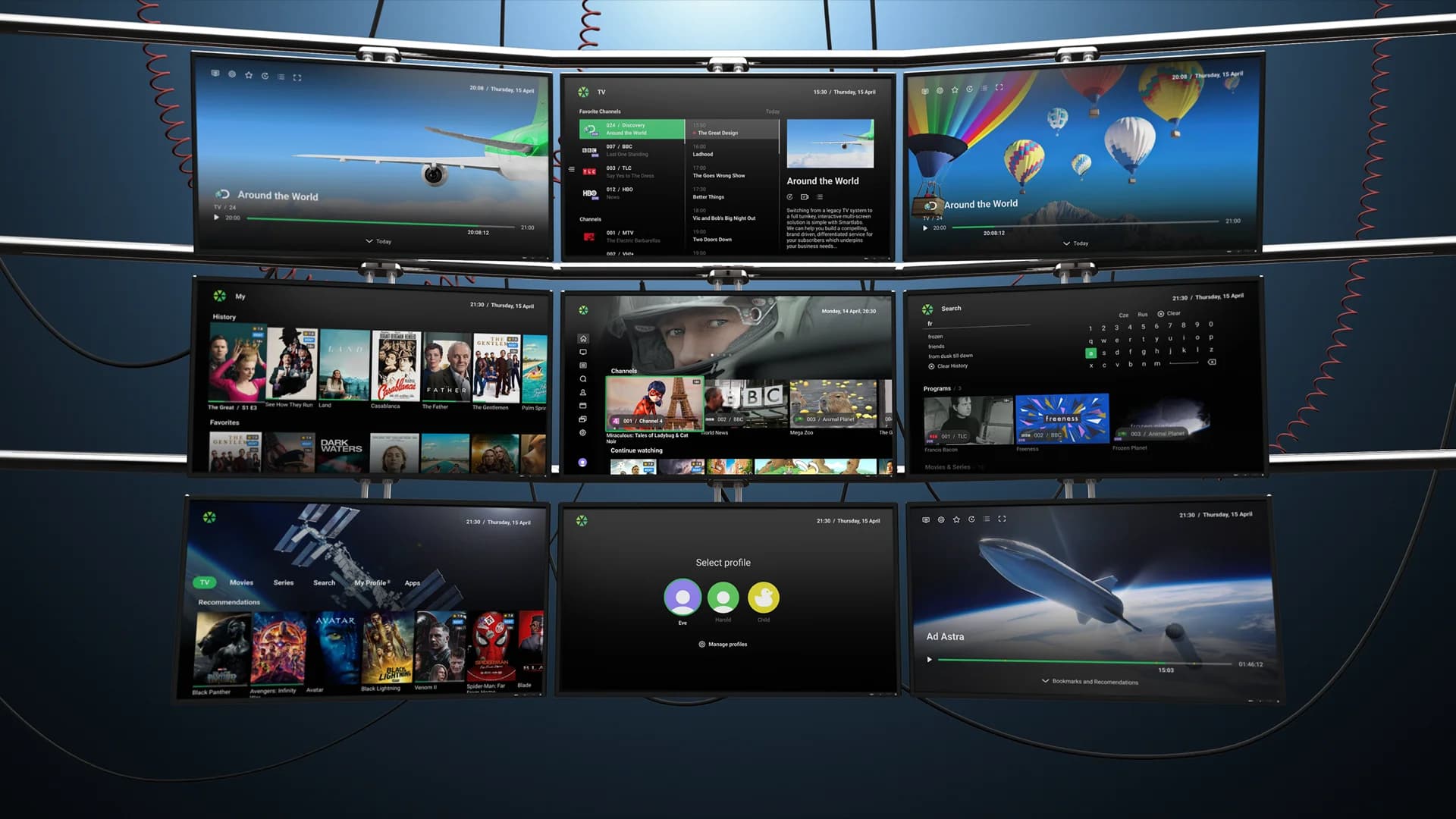
For telecom operators launching or upgrading TV services, IPTV middleware is the platform that ties everything together. It sits between video delivery infrastructure and the applications subscribers actually use — managing service logic, content catalogs, authentication, and the user experience across every screen.
Why we wrote this article
We have been building IPTV and OTT platforms for telecom operators for over 20 years. During this time we have seen firsthand how the term "middleware" creates confusion — both for engineers entering the industry and for decision-makers evaluating platforms.
The word middleware comes from general software architecture, where it describes any software layer that sits between infrastructure and applications. Think of web application servers, message brokers, or API gateways — all are forms of middleware in the broader sense.
In the pay-TV industry, the term was adopted in the early 2000s to describe the orchestration platform between video headend equipment and set-top boxes. At the time, the set-top box was the only client device, and the "middleware" managed channel lineups, program guides, and subscriber entitlements. As the industry evolved to support smart TVs, mobile apps, and web players, the role of this layer expanded far beyond its original scope — but the name stuck.
Today, "IPTV middleware" refers to what is effectively a full service delivery platform: content management, subscriber management, multi-device UI, recommendation engines, analytics, and API integrations. The term no longer fully reflects the scope of what these platforms do, but it remains the industry-standard label that operators use when searching for solutions.
This article is our attempt to provide a clear, vendor-neutral reference for how IPTV platforms are structured — the kind of overview we wish had existed when we started in this space.
What IPTV middleware enables
For telecom operators and pay-TV providers, IPTV middleware enables services including:
- live TV
- video on demand (VOD)
- catch-up TV
- start-over TV
- multiscreen streaming
While video infrastructure handles encoding and distribution, middleware manages service logic, content discovery, subscriber authentication, and user interfaces.
Modern IPTV platforms increasingly combine IPTV and OTT capabilities, enabling operators to deliver television services across both managed networks and the public internet.
IPTV Platform Architecture
A typical IPTV platform consists of several layers that work together to deliver television services.
Simplified Architecture
IPTV Platform Architecture
Each layer performs a different function within the video delivery pipeline.
Key Components of an IPTV Platform
Content Ingestion
Content is acquired from broadcasters, studios, and satellite feeds — live TV channels, sports broadcasts, movie libraries, and on-demand video catalogs.
In practice, ingestion is where many integration headaches begin. Each content source comes with its own format, metadata schema, and delivery method. A well-designed middleware platform normalizes these inputs so that downstream systems — video processing, EPG, and content catalogs — work with a consistent data model.
Video Processing
Video processing infrastructure performs several critical tasks:
- encoding and transcoding
- DRM encryption
- adaptive bitrate packaging (HLS, MPEG-DASH)
- ad insertion preparation
The choice of encoding profiles and DRM systems directly affects both video quality and device reach. Operators targeting a wide range of devices — from legacy STBs to modern smart TVs — need a media processing pipeline that can produce multiple output formats without manual intervention.
Content Delivery Network (CDN)
CDNs distribute video streams to viewers efficiently. Telecom operators often deploy private CDNs within their own networks to ensure low latency, high reliability, and predictable quality of service.
The decision between private CDN, public CDN, or a hybrid approach depends on subscriber geography and network topology. Operators serving a concentrated footprint typically benefit from in-network CDN nodes, while those expanding into OTT delivery often add public CDN capacity for out-of-network viewers.
IPTV Middleware Platform
Middleware orchestrates the entire service. Core functions include:
- channel management and content catalogs
- EPG generation and scheduling
- subscriber authentication and entitlements
- device management
- recommendation systems
- UI configuration
- service APIs
It is essentially the brain of the IPTV platform — the layer that determines what each subscriber sees, what they can access, and how they interact with the service. When operators talk about launching a new TV service, the middleware platform is where most of the business logic lives.
Client Applications
Users access IPTV services through set-top boxes, smart TV apps, mobile apps, web players, and streaming devices. These applications communicate with middleware APIs to retrieve content, authenticate users, and render the viewing experience.
The quality of client applications directly impacts subscriber satisfaction and churn. A middleware platform that provides a robust application framework — with shared UI components, offline support, and consistent behavior across devices — significantly reduces both development time and the surface area for bugs.
Ensuring consistent quality across this device ecosystem requires rigorous testing at every layer. Our QA practices article describes how Smartlabs tests across 20+ device types using a dedicated device lab and automated pipelines.
Key Features of IPTV Middleware
Modern IPTV middleware platforms typically include several core modules.
Electronic Program Guide (EPG)
The EPG is often the first thing a subscriber sees when they turn on their TV. It provides program schedules, channel previews, reminders, and catch-up access.
What separates a good EPG from a basic one is metadata depth and responsiveness. Operators that invest in rich program metadata — descriptions, cast information, genre tagging, editorial collections — see measurably higher content discovery and engagement. A slow or sparse EPG, on the other hand, pushes subscribers toward competing streaming apps.
Subscriber Management
Subscriber management handles authentication, authorization, and entitlement enforcement — who can watch what, on which devices, and under which subscription tier.
This is where middleware meets the business model. Package bundling, device concurrency limits, parental controls, and promotional offers are all enforced at this layer. Getting it wrong leads to either revenue leakage (subscribers accessing content they haven't paid for) or support escalations (legitimate access being blocked).
Content Metadata Management
Metadata powers content discovery — titles, genres, cast, descriptions, artwork, and relationships between content items.
In our experience, metadata quality is the single most underinvested area in operator deployments. Operators often have thousands of VOD assets with incomplete or inconsistent metadata, which degrades search results, breaks recommendation engines, and makes the content catalog feel disorganized. A good middleware platform provides metadata validation, bulk enrichment tools, and integration with third-party metadata providers.
Recommendation Engine
Recommendation systems personalize content suggestions based on viewing history, preferences, and trending content. For operators with large VOD catalogs, recommendations directly impact content consumption metrics and subscriber retention.
The challenge for operators is that recommendation quality depends heavily on the metadata and behavioral data collected by other middleware modules. A recommendation engine is only as good as the data it receives — which is why metadata management and analytics need to work as an integrated system rather than standalone components.
API Layer
Modern IPTV middleware solutions expose APIs that integrate with billing systems, CRM platforms, analytics tools, and advertising platforms. The API layer is what allows the middleware to function as part of a larger service ecosystem rather than as a closed system.
Operators evaluating middleware should pay close attention to API maturity — whether the platform offers well-documented REST or GraphQL APIs, webhook support for event-driven integrations, and SDKs for common integration scenarios.
IPTV vs OTT Platforms
Although IPTV and OTT services share many technologies, they differ in delivery and control models.
| Feature | IPTV | OTT |
|---|---|---|
| Network | Managed telecom network | Public internet |
| Quality control | High (operator controls the network) | Variable (depends on viewer's ISP) |
| Devices | STB + multiscreen apps | Apps only |
| Latency | Lower (optimized network path) | Higher (best-effort delivery) |
| Use case | Telecom pay-TV | Streaming services, cord-cutting |
Most operators now deploy hybrid IPTV/OTT platforms — using managed delivery for the home STB and OTT delivery for mobile and out-of-home viewing. This is why modern middleware must support both models within a single platform architecture.
IPTV Middleware Vendors
Several companies provide IPTV middleware platforms for telecom operators and pay-TV providers.
| Vendor | Platform Focus | Typical Customers |
|---|---|---|
| Smartlabs | IPTV / OTT platform | Telecom operators |
| MediaKind | Video infrastructure + middleware | Operators and broadcasters |
| Synamedia | Pay-TV platform and security | Cable and satellite providers |
| Nagra | Content protection and pay-TV platform | Pay-TV operators |
| Zattoo | White-label IPTV/OTT platform | Telecom providers |
An important distinction when evaluating vendors is scope of delivery. Some vendors provide only the backend middleware platform — the server-side orchestration, APIs, and management consoles — and leave client application development to the operator or a separate integrator. Others deliver an end-to-end solution that includes both the middleware platform and the client applications (STB, smart TV, mobile, web) as a unified product. For a deeper analysis of how operators should approach the build-vs-buy decision — including the risks of vendor lock-in and the real costs of in-house development — see our article IPTV/OTT Platform: Build vs Buy for Telecom Operators.
This difference has significant implications for time-to-market, integration risk, and long-term maintenance cost. When middleware and applications come from different vendors, the operator becomes responsible for keeping them in sync — API version compatibility, feature parity across devices, and coordinated release cycles. A vendor that delivers both the platform and the applications as a single integrated stack eliminates this coordination overhead.
Deployment Models
Operators typically deploy IPTV middleware using one of three models.
On-Premise Deployment
Traditional deployments run entirely within telecom data centers. This gives operators full infrastructure control, simplifies regulatory compliance, and allows optimized network performance.
On-premise deployment remains the preferred model for operators in regulated markets or those with existing data center investments. The trade-off is higher upfront cost and slower scaling compared to cloud alternatives.
Cloud-Based Deployment (SaaS)
Cloud-based deployment provides rapid scaling, simplified operations, and faster geographic expansion. Operators can launch new markets without building data center capacity first.
The shift to cloud has accelerated in recent years, particularly for operators launching OTT services alongside their managed IPTV offering. Cloud deployment also lowers the barrier for smaller operators who previously couldn't justify the infrastructure investment.
Hybrid Deployment
Many operators combine both approaches — video processing in the cloud, middleware in private infrastructure, and distributed CDN nodes across both. Hybrid deployments allow operators to balance performance, compliance, and scalability based on their specific constraints.
For operators running legacy or end-of-life middleware, hybrid deployment often serves as a practical migration path — allowing a gradual transition from an outdated platform to a modern one without a disruptive full rip-and-replace.
Emerging Trends in IPTV Middleware
Cloud-Native Platforms
The shift from monolithic middleware to microservices and container-based architectures is changing how platforms are built and operated. For operators, this means shorter update cycles, independent scaling of components (e.g., scaling the recommendation engine without touching the EPG service), and more predictable infrastructure costs.
AI-Driven Personalization
Recommendation engines are moving beyond simple collaborative filtering toward models that incorporate viewing context — time of day, device type, household member profiles. The operators seeing the best results are those feeding behavioral data back into their content acquisition decisions, not just their recommendation algorithms.
Unified IPTV and OTT Platforms
The distinction between IPTV and OTT is dissolving at the platform level. Operators increasingly want a single middleware backend that serves both managed STB clients and OTT apps, with unified subscriber management, content catalogs, and analytics. Maintaining two separate platforms doubles operational cost without delivering proportional value.
Advanced Analytics
Analytics in middleware is shifting from retrospective reporting (what happened last month) to operational intelligence — real-time quality of experience monitoring, predictive churn indicators, and content performance scoring that feeds directly into catalog curation. The middleware platform is uniquely positioned for this because it sits at the intersection of subscriber data, content data, and delivery metrics.
How Telecom Operators Choose IPTV Middleware
When selecting an IPTV middleware platform, operators typically evaluate:
- Scalability — can the platform grow from tens of thousands to millions of subscribers without re-architecture?
- Device support — does it cover STBs, smart TVs, mobile, and web with a shared codebase?
- Integration capabilities — how mature are the APIs for billing, CRM, and third-party systems?
- Security — does it support multi-DRM, geo-blocking, and concurrent stream enforcement?
- Deployment flexibility — can it run on-premise, in the cloud, or in a hybrid model?
The platform must integrate seamlessly with video infrastructure, DRM systems, CDNs, and customer management systems. Operators that underestimate integration complexity during vendor selection often face costly surprises during deployment.
FAQ
What does IPTV middleware do?
IPTV middleware manages the user experience and service logic of IPTV platforms. It handles channel catalogs, program guides, user authentication, device management, and integration with external systems like billing and CRM.
What is the difference between IPTV middleware and OTT platforms?
IPTV middleware operates primarily within managed telecom networks with guaranteed quality of service, while OTT platforms deliver content over the public internet. Many modern platforms support both models — serving managed IPTV on the home network and OTT delivery for mobile and out-of-home viewing.
Who are the main IPTV middleware vendors?
Major IPTV middleware vendors include Smartlabs, MediaKind, Synamedia, Nagra, and Zattoo. These companies provide platforms used by telecom operators and pay-TV providers to manage multiscreen television services.
Conclusion
The term "middleware" may be a holdover from a simpler era of IPTV, but the platform it describes has never been more important. As operators navigate the convergence of managed IPTV and OTT delivery, the middleware layer is where service differentiation actually happens — in the quality of content discovery, the intelligence of recommendations, and the consistency of the viewing experience across devices.
We wrote this guide because we believe operators make better platform decisions when they understand the full architecture, not just vendor marketing. Whether you're launching a new TV service, migrating from a legacy platform, or expanding into OTT, the fundamentals outlined here apply.
If you're evaluating IPTV middleware solutions for your network, we'd be happy to discuss your specific requirements.